Your best dives. On the biggest screen you own.
Connect DeepSix to your Apple TV. Your trips appear as a browse shelf — site photos, depth badges, trip names. Pick a dive. Your photos fill the screen, one by one, with the dive profile running alongside them.
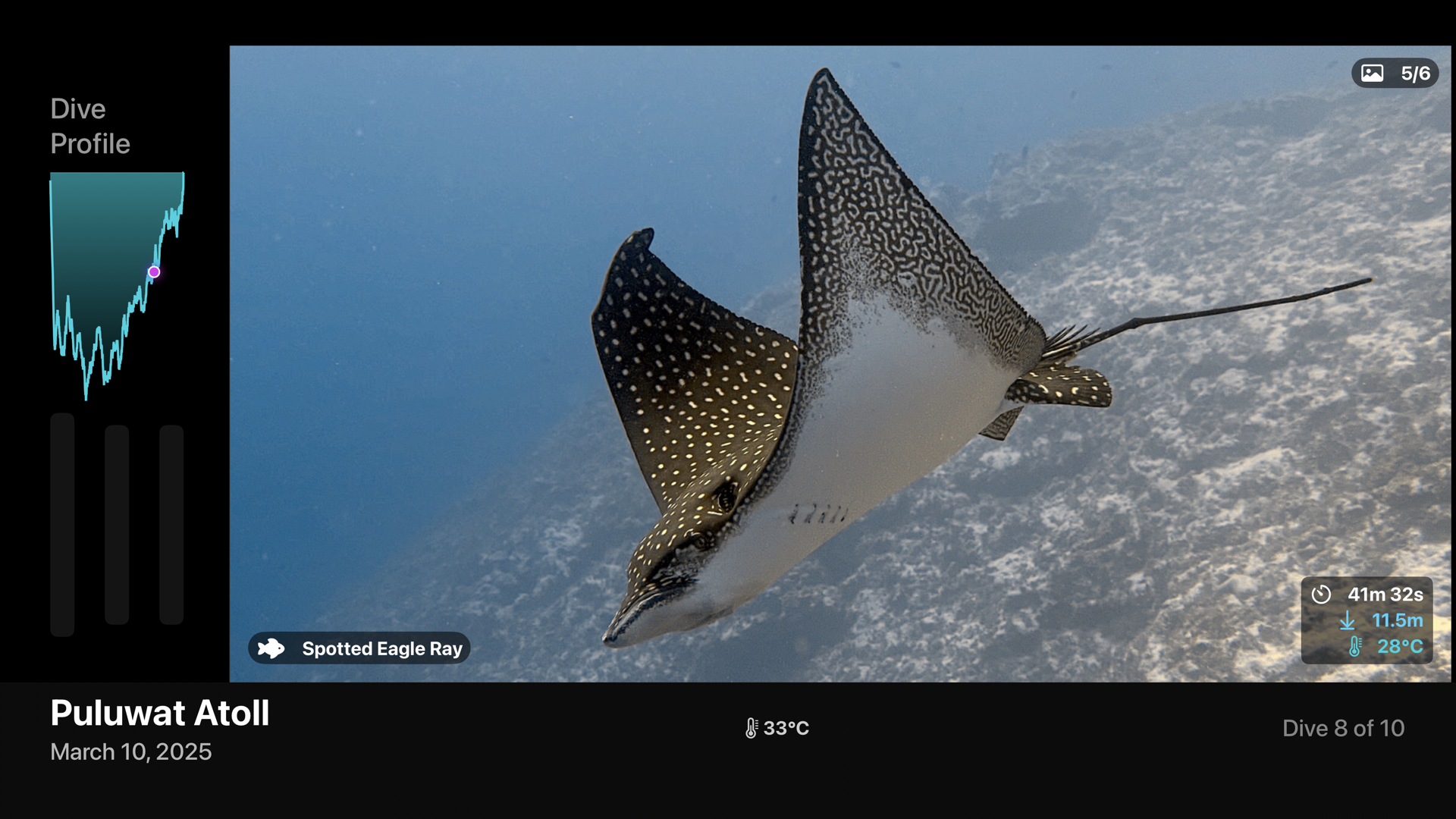
Every photo is placed at the exact moment it was taken. The scrubber dot moves. The depth readout matches the frame. The species badge shows what you were looking at. It's not a slideshow. It's a dive replay.
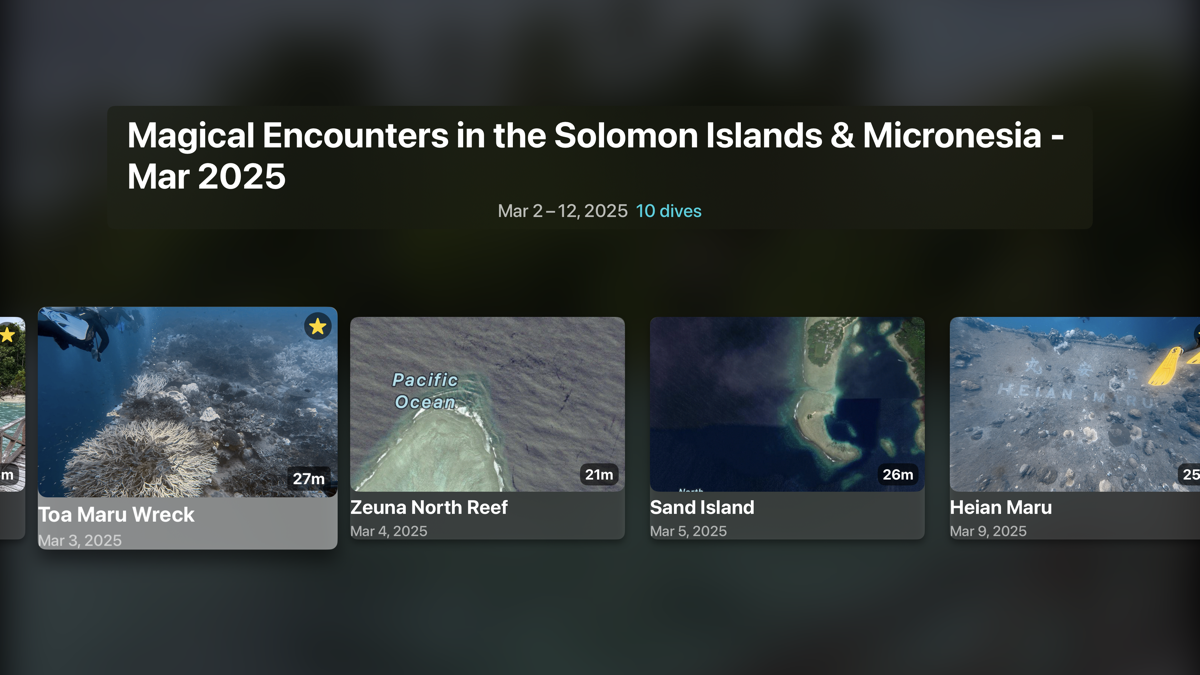
Solomon Islands & Micronesia, March 2025. Toa Maru Wreck, Zeuna North Reef, Sand Island, Heian Maru — each dive a card, each card a memory. Depth badge on every one.
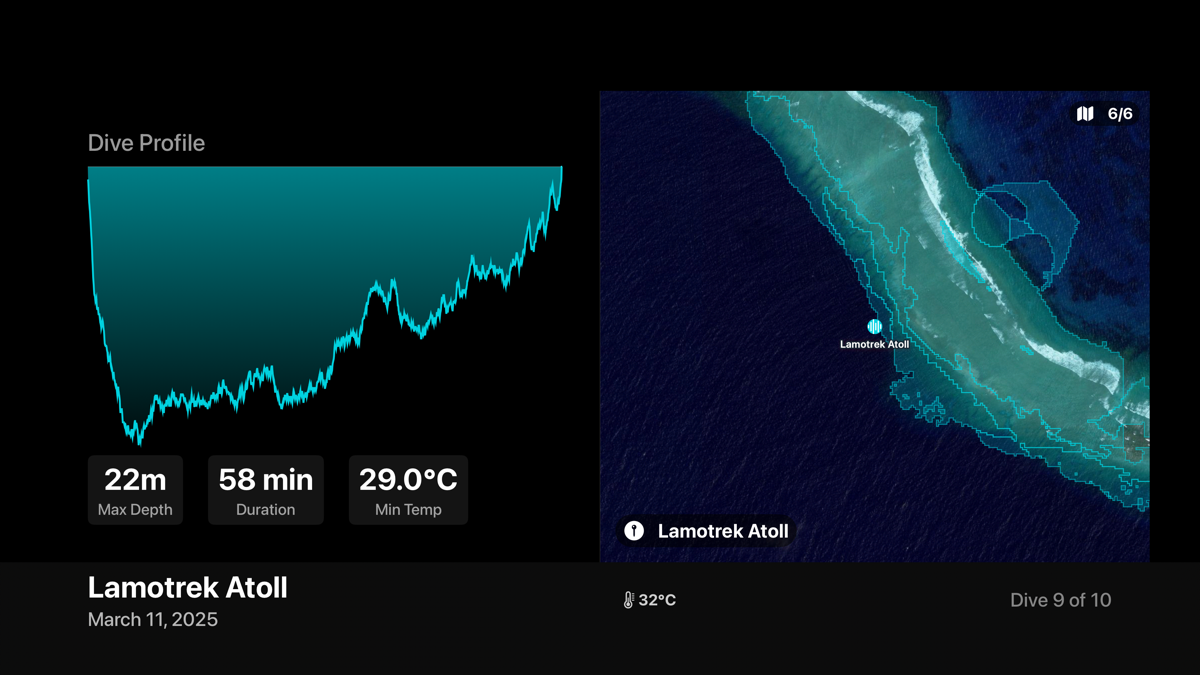
Lamotrek Atoll, March 11 2025. Profile chart left, satellite map right. 22m max, 58 minutes, 29°C. Dive 9 of 10 on a liveaboard trip through Micronesia.
41 minutes and 32 seconds into the dive. 11.5 meters. 28°C.
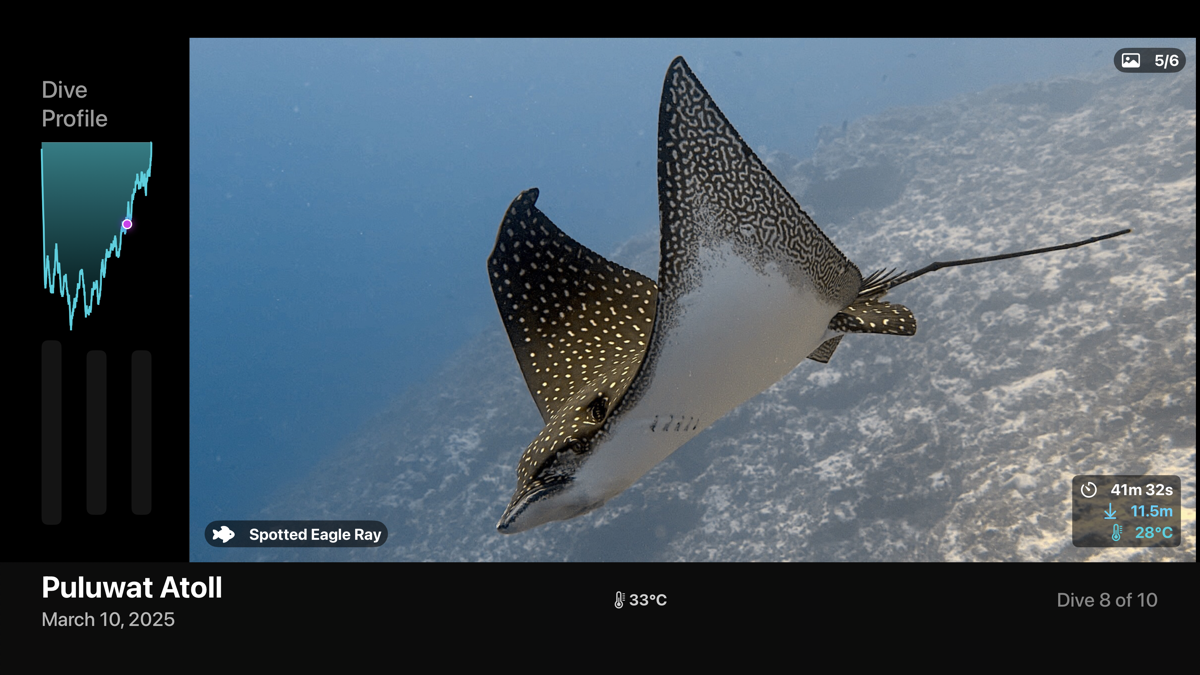
Puluwat Atoll, March 10 2025. The profile thumbnail top-left shows exactly when this photo was taken — the scrubber dot is live. Species badge: Spotted Eagle Ray. Depth 11.5m, temperature 28°C, 41 minutes 32 seconds into the dive. Dive 8 of 10.
Every matched photo carries three pieces of data that no other dive log records: the depth at the moment of the shot, the GPS coordinate interpolated from entry and exit, and the exact minute on the dive profile.
The Spotted Eagle Ray frame isn't just a photo from Puluwat Atoll. It's a photo taken at 11.5m, 41 minutes and 32 seconds into dive 8 of a 10-dive liveaboard trip through the Caroline Islands, in March 2025. That's the difference between a file and a memory.
Every trip. Every dive. On the biggest screen you own.
The tvOS home screen shows your dive history as a globe with pinned sites and a trip list. Select a trip — the view flies to your sites and shows every dive as a card. Site photo or satellite map, depth badge, date. Scroll through the Solomons trip and Toa Maru, Zeuna North Reef, Sand Island, and Heian Maru are each a card.
Your log is a travel record as much as a dive record. Zanzibar and the Jewels of the Indian Ocean. Solomon Islands. Micronesia. Komodo. On the TV, that context lands differently than on a phone screen.
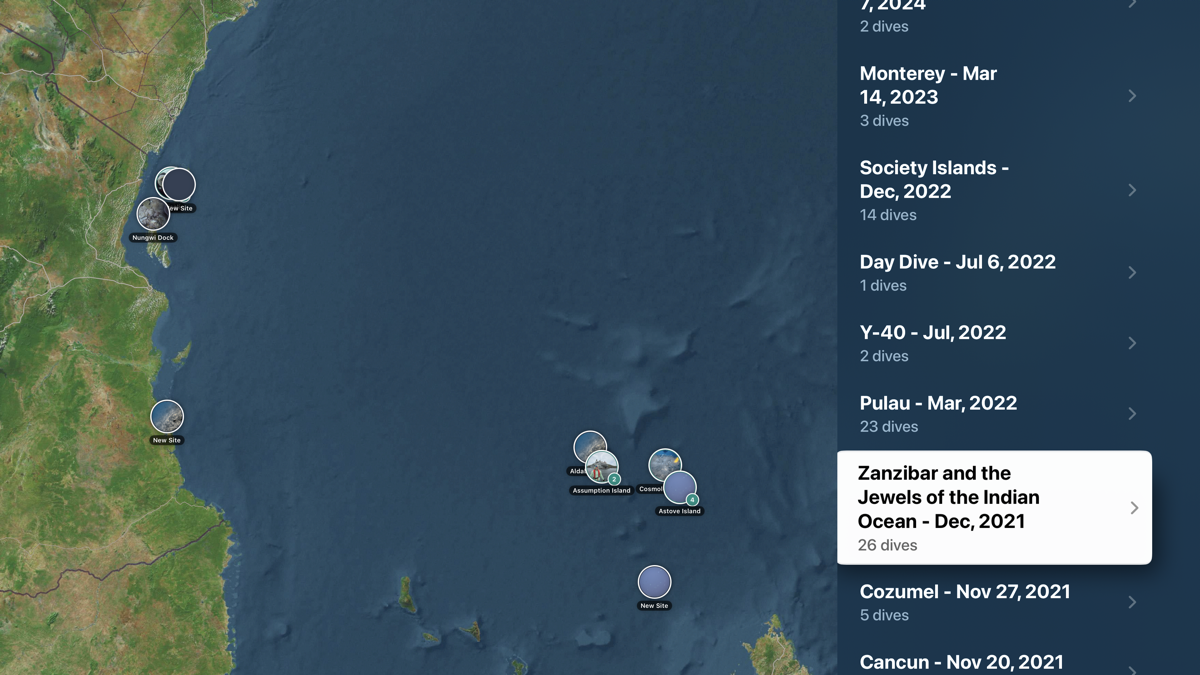
tvOS home. Zanzibar and the Jewels of the Indian Ocean selected — 26 dives. Assumption Island, Cosmoledo, Astove Island pinned on the globe. Indian Ocean outer atolls.
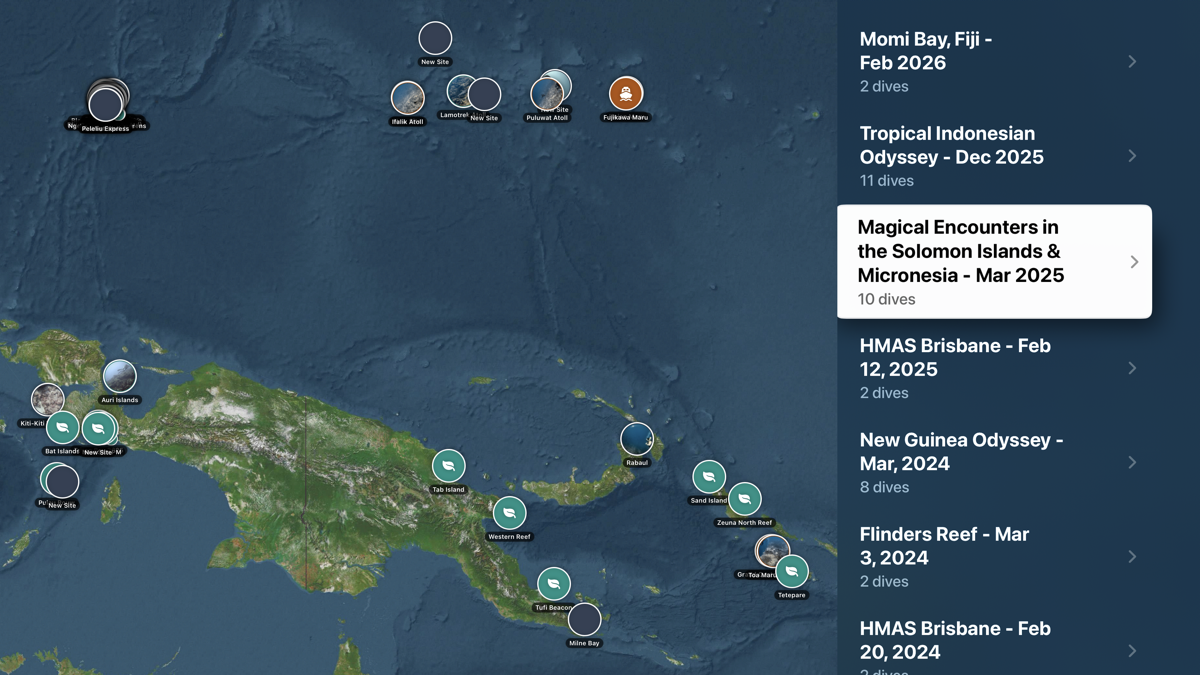
The western Pacific — Papua New Guinea, Solomon Islands, Micronesia. Magical Encounters in the Solomon Islands & Micronesia, March 2025. 10 dives. Fujikawa Maru wreck icon visible.
Not just a file. A record.
Written back to the photo in Photos.app. Your library knows where those coral photos were taken — not just that they were taken underwater.
The red channel doesn't survive below 5 meters. We bring it back.
Underwater photos lose red first, then orange, then yellow. By 20 meters your camera is recording a world that only exists in blue and green. DeepSix corrects for depth — not a flat filter, but a depth-aware algorithm that knows how much red was lost at 18 meters versus 5 meters.
On-device, non-destructive, free. Your photos in Photos.app are never overwritten — the correction is stored as an adjustment layer, reversible with a tap.
You were there. The photo just didn't know it yet.
The Paralenz was doing its best. It corrected what it could in real time, in a sealed housing, with the compute available in 2015. The algorithm running in DeepSix in 2026 is better. And it doesn't care when the photo was taken.
Depth-adaptive color correction works on every photo in your library. The depth data is already in your dive log. The correction is better now. Your archive is worth revisiting.
The dive was always this good.
Sometimes the best part of the dive
is above the water.
The boat ride out. The surface interval. The debrief on the back deck. The beer at 4pm when everyone's talking about the manta they saw and nobody agrees on the wingspan.
DeepSix scans your Photos.app for the 45 minutes before and after each dive and tags those photos as surface memories. They're part of the record. They're available as hero images. They show up in your trip on Apple TV alongside the underwater shots. They just don't get placed on the depth profile — because they weren't there, and the profile should be honest.
Surface memories are day-wide. The boat ride out at 8am shows in every dive that day — not just the first one. Photos from your partner touring inland while you're underwater don't appear at all: DeepSix filters out any photo taken more than 5km from the dive site.
Critter ID doesn't run on surface photos. The algorithm knows you weren't photographing fish from the surface interval. Your API credits go to the photos that need them.
"45 minutes before. 45 minutes after.
The whole dive, not just the wet part."
One hero. Up to five highlights. Your call.
Every dive has a Hero — the single photo that represents it on the dive list and everywhere the dive appears — and Highlights, the curated set of up to five that lead the dive. They're separate decisions with separate badges: the hero wears a star, the highlights wear sparkles. DeepSix picks both automatically, but you're never stuck with its taste — long-press any photo to Set as Dive Hero, and tap the current hero to clear it back to the automatic pick.
The scene classifier keeps the galleries honest, too. Not everything shot on a dive day is a dive photo — the slate, the gauge check, the screenshot of the briefing. Those land in their own Non-Dive Photos bin instead of your galleries, and a three-way Dive / Surface / Non-Dive control in photo detail lets you overrule the classifier — your manual call sticks.
And a dive with no photos at all still gets a face: its list row falls back to the site's reference image, so a photo-less dive never scrolls by as a gray square.
The Spotted Eagle Ray has a name. So does everything else.
Claude analyzes every photo from a dive and returns the species name, scientific name, family, and a confidence score. High-confidence IDs build your lifetime species database. Every Aetobatus narinari across every dive is connected.
GPS coordinates go with every identification request — a ray at Puluwat Atoll narrows to different candidates than the same shape in the Red Sea.
Your camera clock was wrong. We corrected it.
Your dive computer, camera, and Apple Watch all disagreed on the time. DeepSix measures the clock offset from each source and applies it to every photo match. Tell it which photo was first — it calculates the last, accounting for drift. Every photo between them is matched to depth and time automatically.
Photos already matched to another dive show orange conflict badges when you scan a new one. The system knows what it's already claimed.
Their shots. In your log.
The photographer on the dive has the good frames. DeepSix is building direct device-to-device transfer — no internet, no cloud, no cables. Two iPhones on the same liveaboard. Their photos go through the same clock-offset matching. They land on your dive at the right depth, the right GPS, the right minute.
Works with AirDrop, SD cards, and any app that can share to DeepSix. The pipeline is the same regardless of how the photo arrives.
385 dives. 10,833 photos. Every one remembered.
Install DeepSix and import your dive history.
Your photos will know where they were taken.
- Achievements →
- AI Features →
- Apple TV →
- DeepSix Dive Log on Mac →
- Garmin FIT Import →
- Gear & Kits →
- GPS Extraction →
- Interactive Dive Map →
- MacDive Import →
- Marine Life ID →
- Photo Color Correction →
- Reef Context →
- Smart Lists →
- Suunto JSON Import →
- Tides & Conditions →
- Time Reconciliation →
- Translations →
- Trip Planner →
- Wonders →
- Wrecks →