70 species.
23 photos.
One dive.
DeepSix Dive Log identifies marine life in your dive photos — common name, Latin binomial, family, confidence score. Results feed a lifetime species database organized by taxonomy. You can also log species yourself from more than 200 pre-loaded families covering everything from Acanthuridae to Zoarcidae.
The AI is the top of a pyramid. Most of the work happens on your device before anything reaches the cloud — and with the free Critter Expert model, most common marine species never need the cloud at all. No account, no API key, no internet after a one-time download.
Your hardware handles the cheap work. The cloud handles the hard part.
Every photo from a dive passes through four stages before a species is confirmed. Most photos never leave your own hardware at all — and the first two stages are free for everyone.
Vision rejects: empty blue water, blurry sand, equipment shots, surface photos, anything with no salient objects.
The cloud never sees them. You're not charged for them.
A species specialist in your pocket. No key. No cloud. No cost.
If you never set up cloud AI, this tier is for you. One 63 MB download — a single tap in AI & Intelligence settings — and Critter Expert identifies marine life entirely on your device. No account, no API key, no internet after the download; species updates are a megabyte or two. It runs on the Neural Engine in about 10 milliseconds a photo, so a whole dive's photos are suggested before you've toweled off.
It knows around 500 marine species, and the number climbs with each catalog update — reef fish from every major basin, sharks and rays, turtles, nudibranchs, photo-identifiable corals and anemones, crustaceans, octopus and squid. It knows where you dived, too: rankings are confined to your dive's ocean basin, it won't suggest a saltwater animal on a freshwater dive (or the reverse, unless the species lives in both), and a photo can yield several identifications when Vision finds more than one subject in the frame — and a frame that's mostly diver is skipped, not named. Suggestions appear with a "Critter expert" label and always wait for your review — nothing is confirmed for you. To run it over dives you already have, select them in the Dives list and choose Identify Critters.
Built clean-room, measured in the open. The backbone is Meta's DINOv2 (Apache-2.0), and it learned its species from iNaturalist Open Data — openly licensed photos. Every training photo is listed publicly with its photographer and license (CC0 and CC BY), and every iNaturalist photo the app shows you links back to the observer's photo and its license. Because we'd rather show you a real number than an adjective: on the published benchmark's photos, which it has never seen, the right species is in its top suggestions 77% of the time, and its first guess is right about half the time. Every batch of species added since has had to pass the same kind of held-out evaluation before it ships — tranches that miss the bar stay out until curation fixes them.
The whole benchmark — imagery manifests, scoring harness, results — is public. Run it yourself: github.com/rbollar/fishial-benchmark. The per-photo credits are in its attribution section and manifests.
The model will miss species it doesn't know — that's what the review step is for, and why every suggestion stays a suggestion until you confirm it. Add a cloud key later and Critter Expert keeps working as the offline fallback.
When it gets one wrong, or doesn't know it at all, you can share that photo to help it learn: pick the open license you're happy with, choose whether you're credited, and see exactly what will be sent before anything leaves your phone. No coordinates go with it, and a person reviews every photo before it's used. Details on the privacy page.
More than 200 families. No internet required.
DeepSix ships with a complete marine taxonomy database — more than 200 families across 16 categories, from Sharks & Rays to Nudibranchs to Coral. You can log any species yourself by common name or family, and the app resolves it to the correct Latin binomial on-device.
Type "Moorish Idol" and it returns Zanclus cornutus, Zanclidae, Fish. No API call. No internet. Works on the boat, underwater on iPhone, anywhere.
Birds, land animals and insects round out the 16 categories — for what you see from the boat and on the walk in. Every identification — AI or manual — goes into the same database.
Scientific underneath. Yours on top.
Every critter is stored by its scientific name — that's the canonical record, and it never changes. But the label you read is yours. Long-press any family or group, pick "Name this Group…", and rename it to whatever you actually call it, with an optional AI suggestion in your own language.
Want to call a whitetip reef shark a "guppy"? More power to you. Triaenodon obesus stays intact underneath, your dive counts and photos stay attached, and the override syncs across your devices. Changed your mind? It's reversible. The science stays rigorous; the labels are yours.
Checked against the register the scientists use.
Species names drift — AI mistypes them, taxonomists revise them, and a name you logged years ago may since have been reclassified. Open any species and DeepSix Dive Log checks it against the World Register of Marine Species — the taxonomic authority marine biologists actually use. Misspellings, outdated synonyms, and superseded names get flagged with the accepted name and a one-tap fix.
Phonetic matching catches the AI's creative spellings too. Your logbook stays citizen-science grade without you doing the librarian work.
Live results as each photo is analysed.
Tap "Identify Critters" on any dive. DeepSix runs the pre-screen, then sends qualifying photos to your AI provider one at a time. Results appear as each photo returns — species list building in real time, confidence scores color-coded as they arrive.
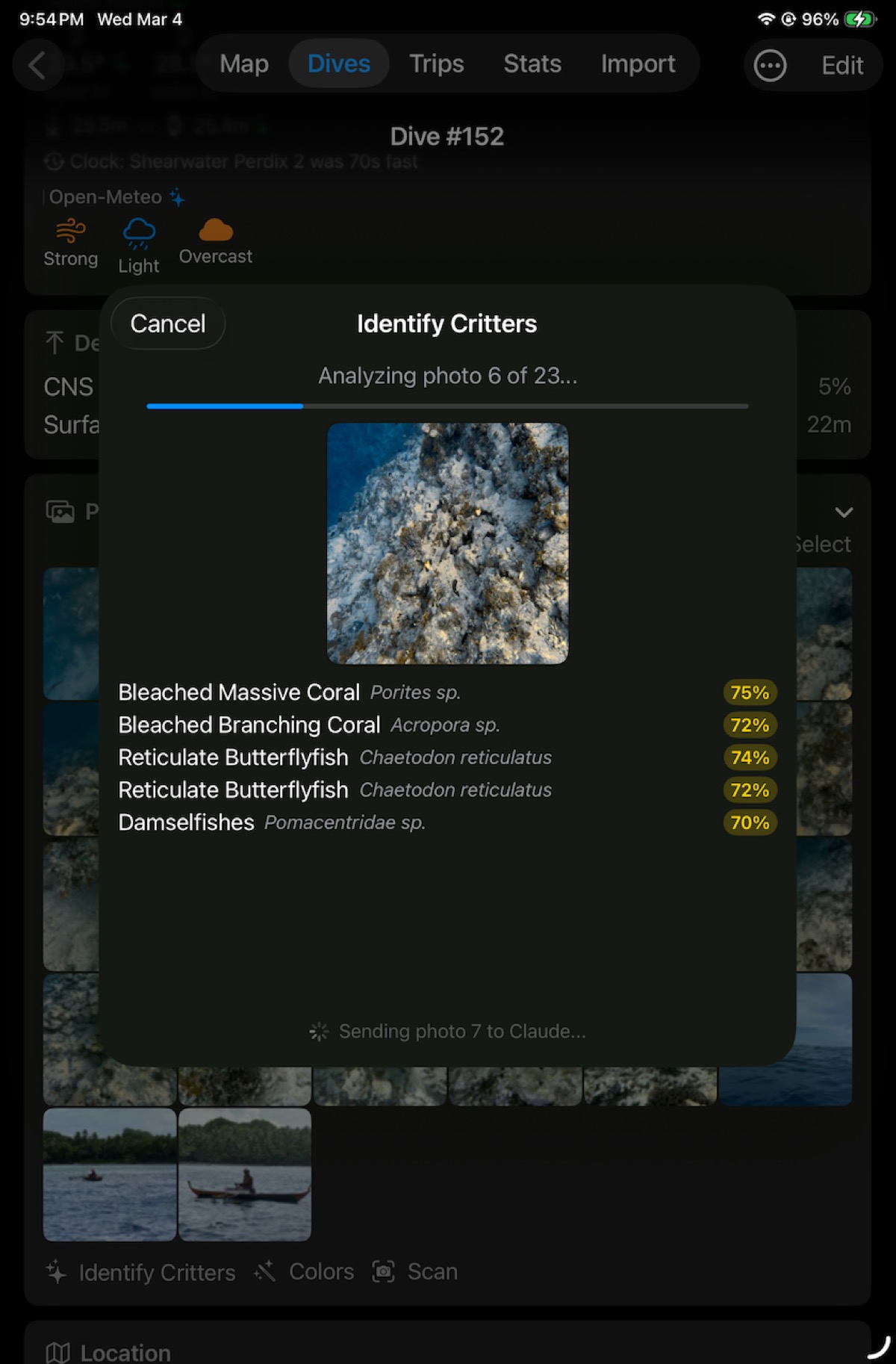
Analysing photo 6 of 23. Dive #152, Chuuk Lagoon. Current photo: coral reef with bleaching. Live results: Bleached Massive Coral Porites sp. 75%, Bleached Branching Coral Acropora sp. 72%, Reticulate Butterflyfish Chaetodon reticulatus 74%. "Sending photo 7 for identification…"
The same photo that shows butterflyfish also shows bleached coral. Both get identified. Your species list and your reef health record update from the same frame.
70 species. 15 high confidence. Best Photo.
When the run completes: total species found, photos analysed, high-confidence count, and the Best Photo — the single frame that yielded the most identifications.
Green badge: ≥80% confidence. Amber: 70–79% — correct more often than not, worth a second look. Anything below threshold goes to Needs Review.
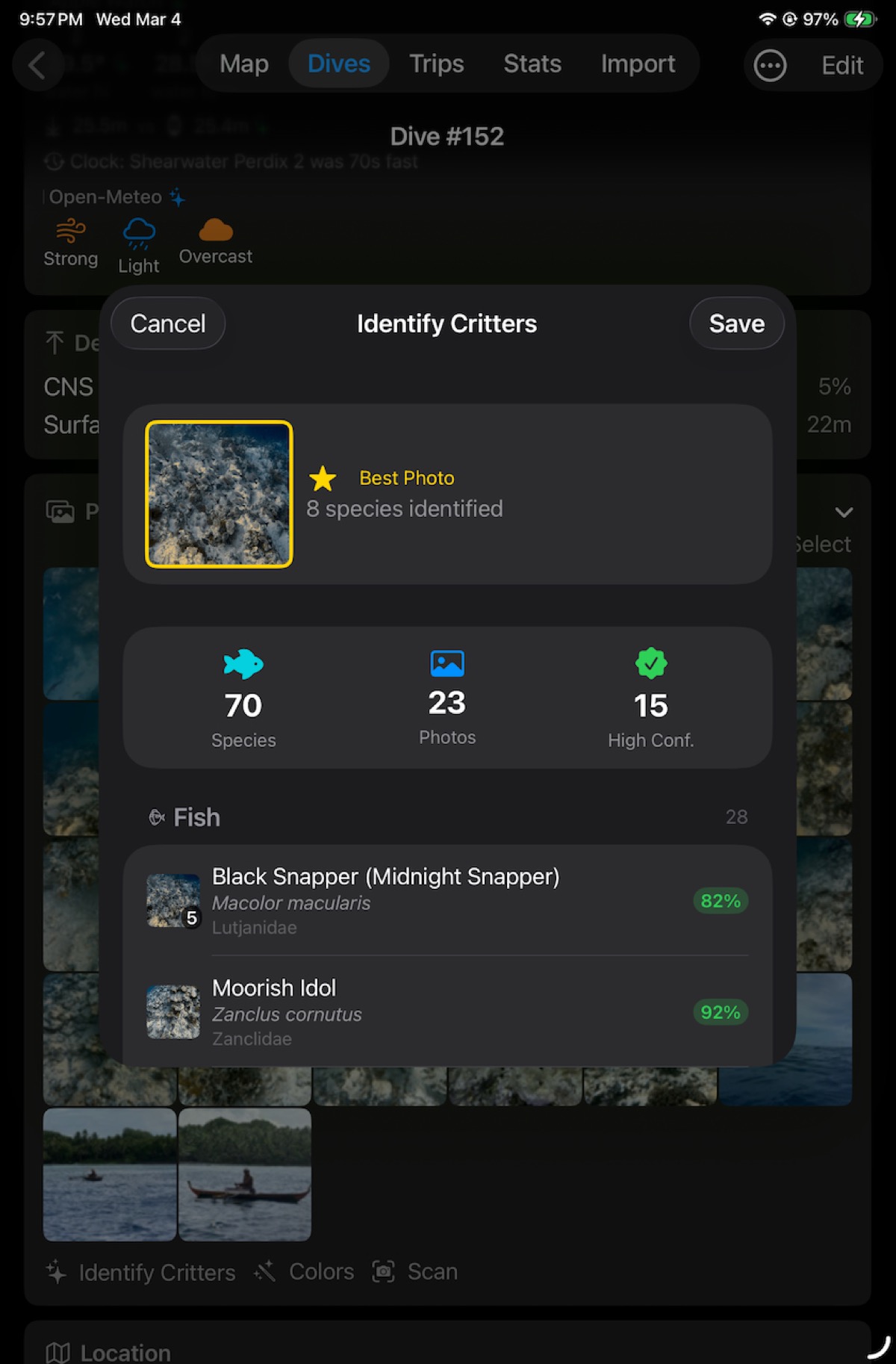
Dive #152. 70 species, 23 photos, 15 high confidence. Best Photo: 8 species in one frame. Fish section: Black Snapper (Midnight Snapper) Macolor macularis 82%, Moorish Idol Zanclus cornutus 92%.
Every species. Organized by taxonomy. Across every dive.
Every identification — AI-generated or manually logged — builds the same database. Stats → Marine Life shows the 16 top-level categories. Tap Fish and you get 143 individual species organized by family. Tap Butterflyfish and you see every Chaetodontidae you've ever logged — species, Latin binomial, dive count, best photo.
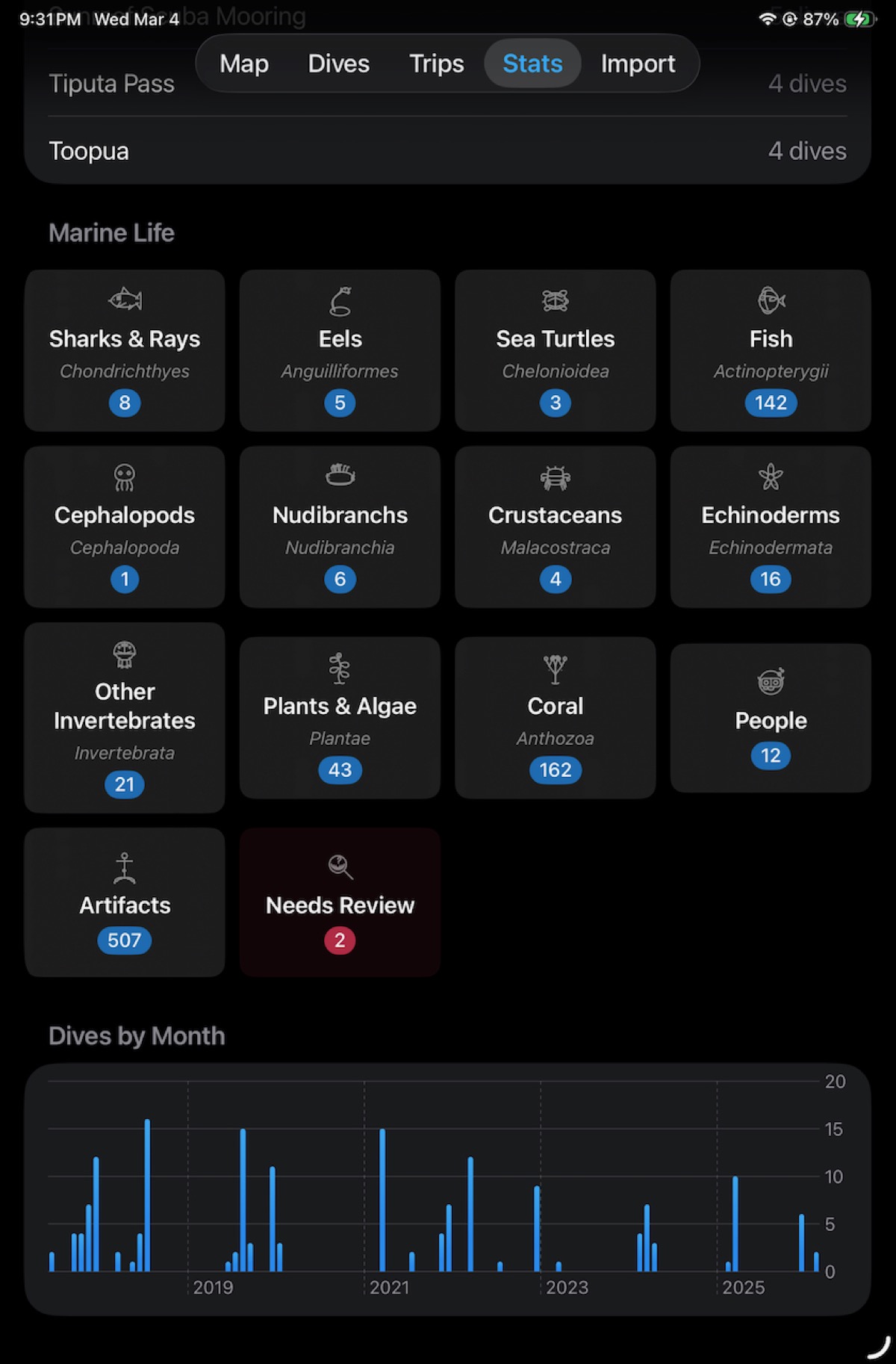
Marine Life overview. 13 populated categories shown. Fish: 142. Coral: 162. Artifacts: 507. Needs Review: 2 (red badge — quality control inbox).
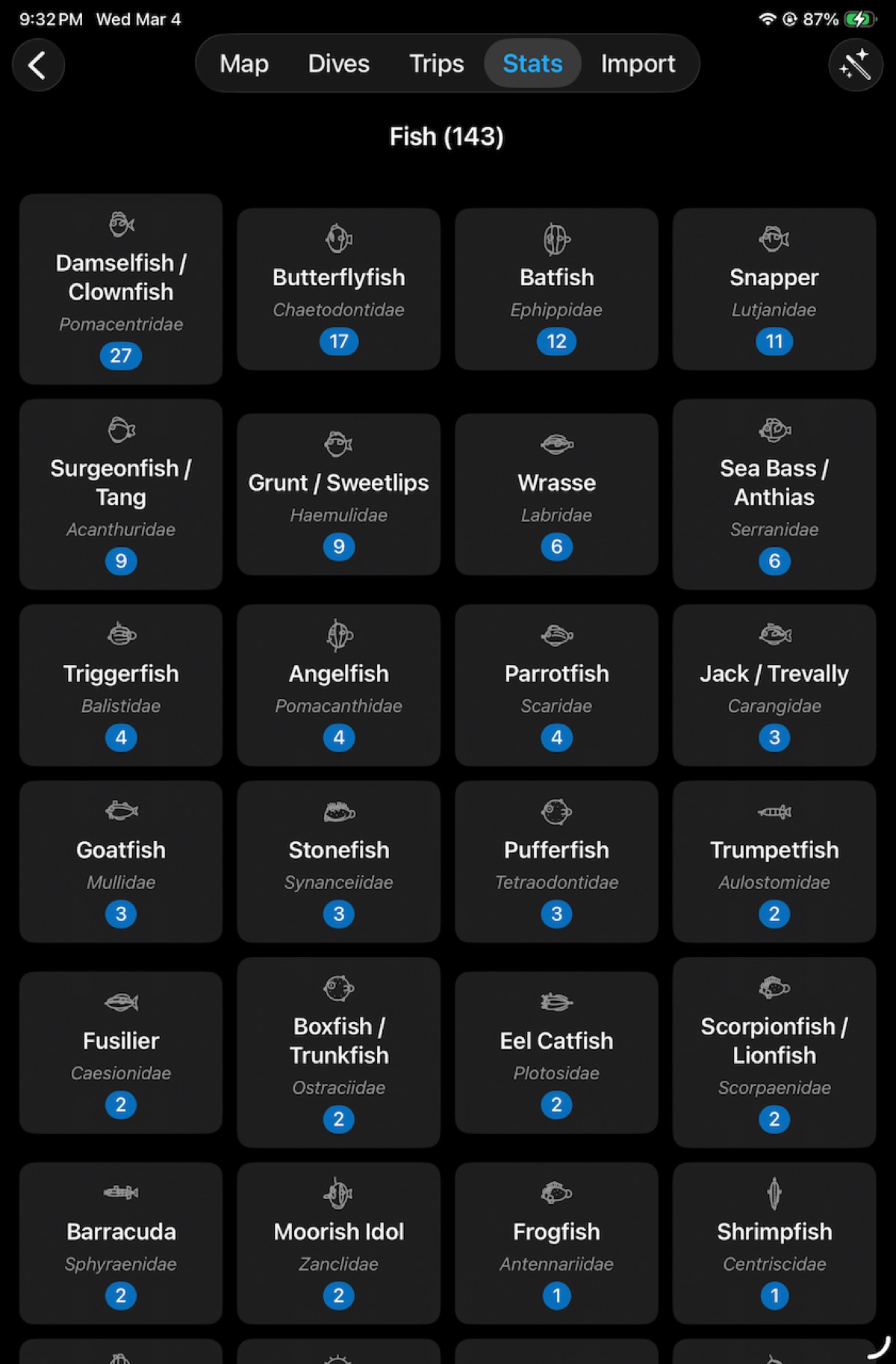
Fish (143) by family. 24 families identified from 46 in the database. Damselfish/Clownfish (27), Butterflyfish (17), Batfish (12). Latin family name on every card.
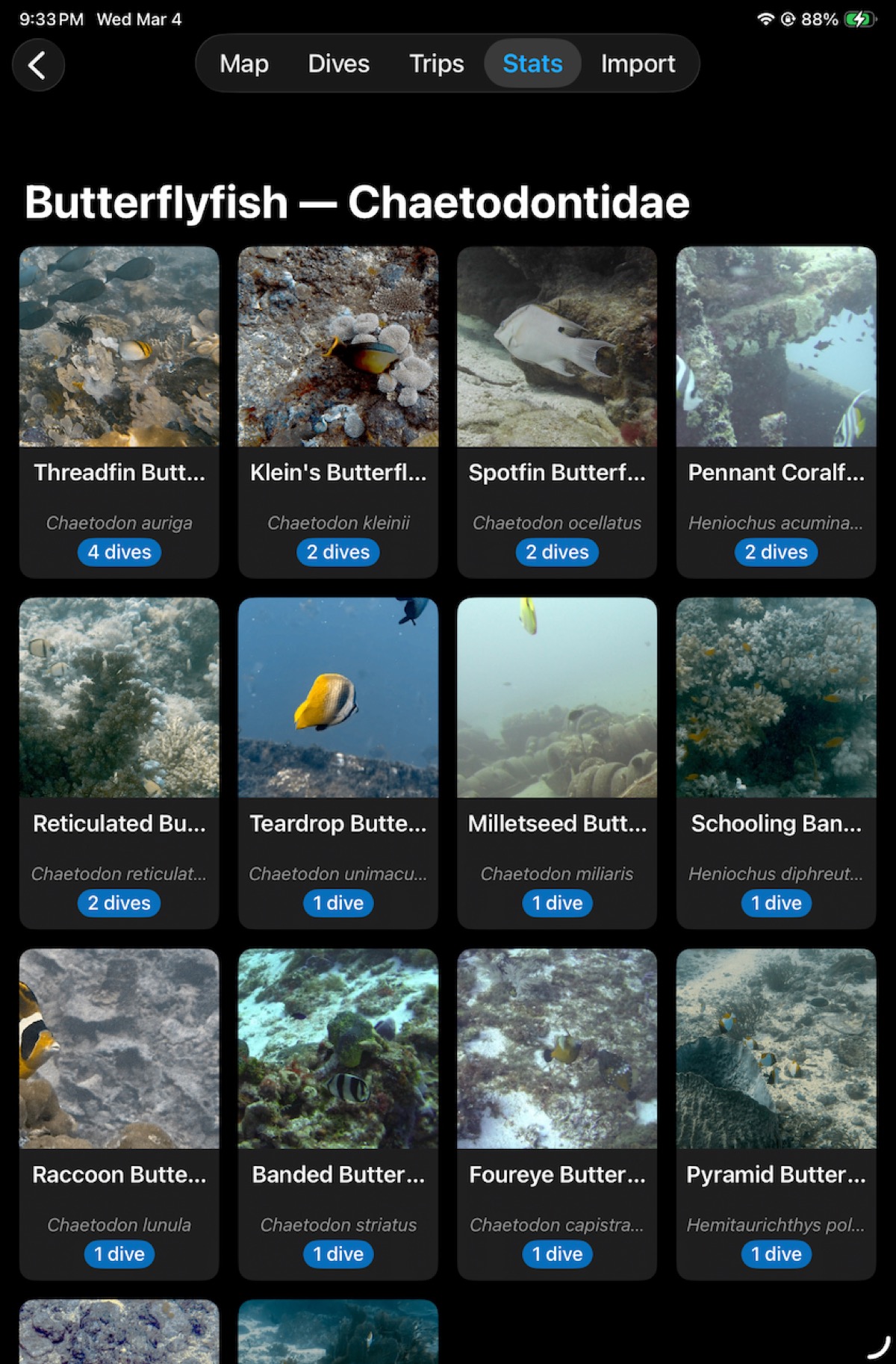
Butterflyfish — Chaetodontidae. 12 species identified across multiple dives. Real photos. Threadfin Butterflyfish Chaetodon auriga: 4 dives. Pyramid Butterflyfish Hemitaurichthys polylepis: 1 dive. Tap any card to see the dive where it was photographed.
The same shape means different species in different oceans.
DeepSix passes the dive's GPS coordinates to every identification request. A butterflyfish in the Red Sea narrows to different species than the same silhouette in the Coral Triangle. A triggerfish off Grand Cayman is almost certainly Xanthichthys ringens — not the Picasso Triggerfish you'd expect in the Indo-Pacific.
Location context eliminates ambiguity that visual shape alone cannot resolve.
Common in the Coral Triangle. Identification narrowed by location — not just by appearance.
The best frame from every dive. Chosen automatically.
After identification, DeepSix scores every photo using three on-device Vision signals: Apple's composition and quality assessment (40%), animal presence bonus (35%), and salient object sharpness (25%). The highest-scoring photo becomes the dive hero — used in the dive list, the travelogue, and tvOS Dive Theater.
This runs entirely on-device. No API call. The scoring happens after the AI has identified what's in the frames.
The inbox for anything uncertain.
Identifications below the confidence threshold go into Needs Review — visible in the category grid with a red badge. Tap it to see the photos and decide: confirm the ID, correct it, or dismiss it.
Two IDs needing review on a 70-species dive is normal. It means the threshold is working.
Bring your own key, your own model — or nothing at all.
With nothing configured, Critter Expert covers common marine species for free, forever. For the full range — anything beyond its catalog — add your own Anthropic or OpenAI API key and pay the provider directly — typically a few cents per dive, at their published rates, with no DeepSix markup. Or run a vision model on your own Mac. There are no credit packs and no DeepSix AI charges of any kind.
Vision pre-screening means you're only paying for photos that actually contain marine life. The 23-photo dive above used roughly 15–18 API calls after Vision filtered the rest.
What did you actually see on that dive?
Download the free fish model in Settings — no key needed — or add your Anthropic or OpenAI key for the full range. Then run Identify Critters on any dive with photos.
Download on the App Store → Testers: TestFlight →- Achievements →
- AI Features →
- Apple TV →
- DeepSix Dive Log on Mac →
- Garmin FIT Import →
- Gear & Kits →
- GPS Extraction →
- Interactive Dive Map →
- MacDive Import →
- Photo Color Correction →
- Photos & Memories →
- Reef Context →
- Smart Lists →
- Suunto JSON Import →
- Tides & Conditions →
- Time Reconciliation →
- Translations →
- Trip Planner →
- Wonders →
- Wrecks →