Why DeepSix is built this way,
and whose work it stands on.
A dive is over in an hour. The reef, the wreck and the eagle ray that passed overhead stay with you much longer. DeepSix Dive Log is built so you can go back to them.
This page covers the choices behind it: what we bring together, why it’s built for Apple devices, how your data leaves with you, and the work of others it stands on.
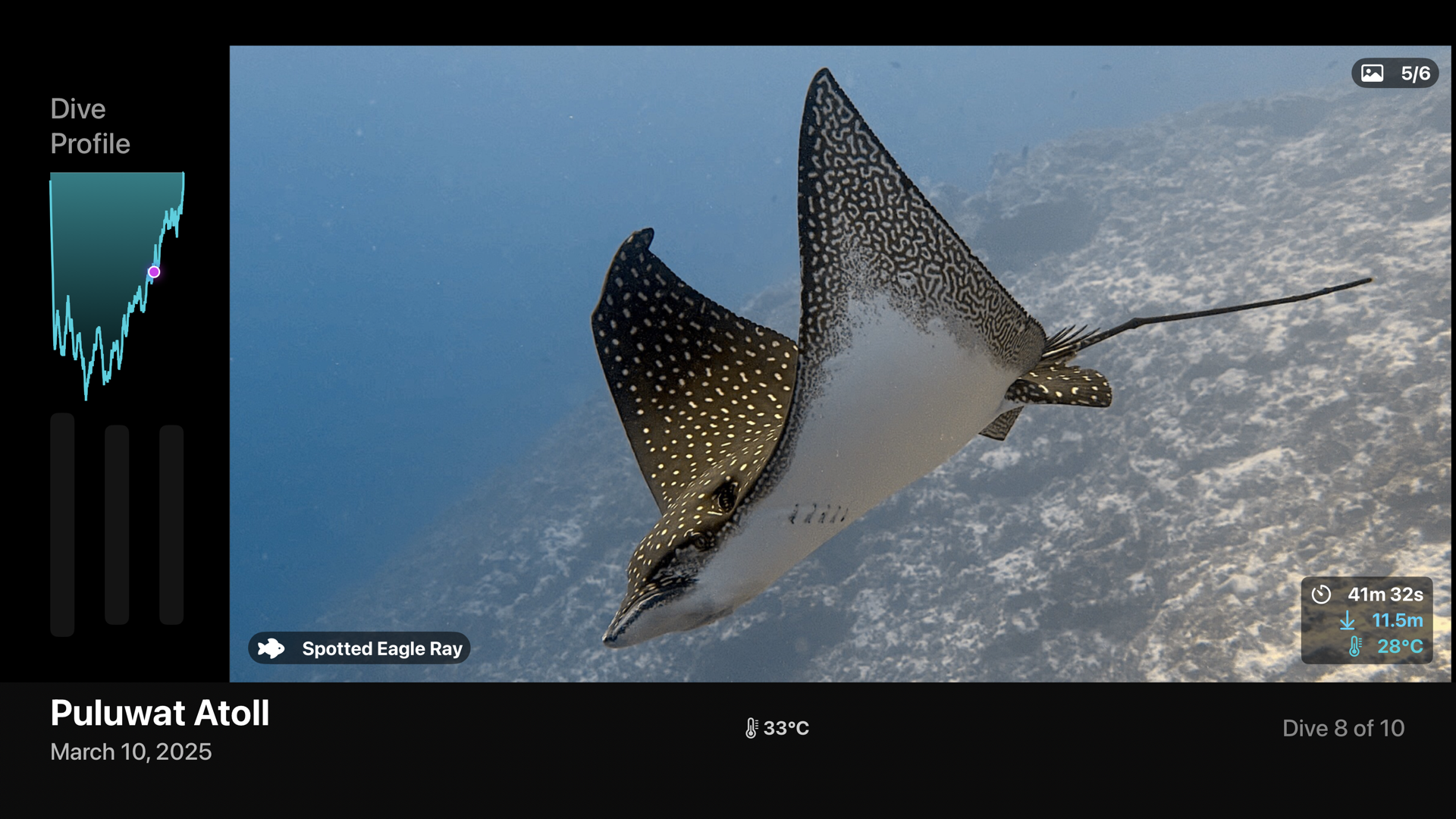
One place to relive your dives
Your dive computer records depth and time. DeepSix adds what was around you, and keeps it with the dive.
So a dive from years ago opens to what it was like, not just the numbers.
Built for Apple devices
DeepSix runs on iPhone, iPad, Mac, Apple TV and Apple Watch Ultra. Each one has its own layout, not a phone screen made bigger.
Your log syncs between them through your own iCloud account. It isn’t stored on our servers. Much of the work happens on your device, including color correction and the free species model.
We build on Apple’s current frameworks, because they’re what make this work the same way on every device:
- SwiftUI: the layouts on every device
- SwiftData and CloudKit: your log, synced through your own iCloud account
- Metal: color correction on the graphics chip
- Core ML and Vision: the free on-device species model
- Foundation Models: Apple Intelligence, on your device
- MapKit and Swift Charts: maps and dive profiles
- Core Bluetooth: downloading from dive computers over Bluetooth
See DeepSix on Mac and DeepSix on Apple TV.
Your data leaves with you
Exporting your log is free. DeepSix exports UDDF, the open standard for exchanging dive logs, and Subsurface XML. Each keeps as much as that format can hold.
Neither format can hold everything DeepSix knows about a dive, such as its reef context, achievements and gear service records. For that there’s the Portable Archive: an open, self-describing export format, so your log is never locked in. It’s a standard ZIP of plain JSON that describes every field it holds, so anyone can read it or write a converter from it.
DeepSix also imports from MacDive, UDDF, Subsurface, Garmin and Suunto (beta), and downloads directly from dive computers through libdivecomputer.
For what stays free and what happens to your data if we ever stop, see Pricing Philosophy.
Privacy and security
From the start, DeepSix has collected nothing except what you choose to send us, such as a diagnostic report, a wreck or Wonder contribution, or a photo you submit. Your log is kept on your devices and in your own iCloud account, not on our servers. If you add a cloud AI key, what you send for AI goes straight to that provider. The AI Deep Dive covers what each AI option sends, and where.
Security review is part of every release, to protect your data. For the details, see Privacy.
Built on others’ work
We logged our own dives in MacDive for years, as many DeepSix users did. For a long time it was the best dive log on the Mac, and we respect what it built. Subsurface is a widely used open-source dive log with a solid import and export format, and DeepSix reads and writes it.
DeepSix talks to dive computers through libdivecomputer, which Jef Driesen has maintained for years. Color correction starts from Nikolaj Bech’s algorithm. Reef, ocean and wreck data come from open sources, such as the Allen Coral Atlas, NOAA Coral Reef Watch, Marine Regions and Wikidata.
Every project, its license, and every photo credit is on the Attributions page.
Giving back
DeepSix isn’t open source yet. Some of the work it needed is, and we’ve published it for others to use.

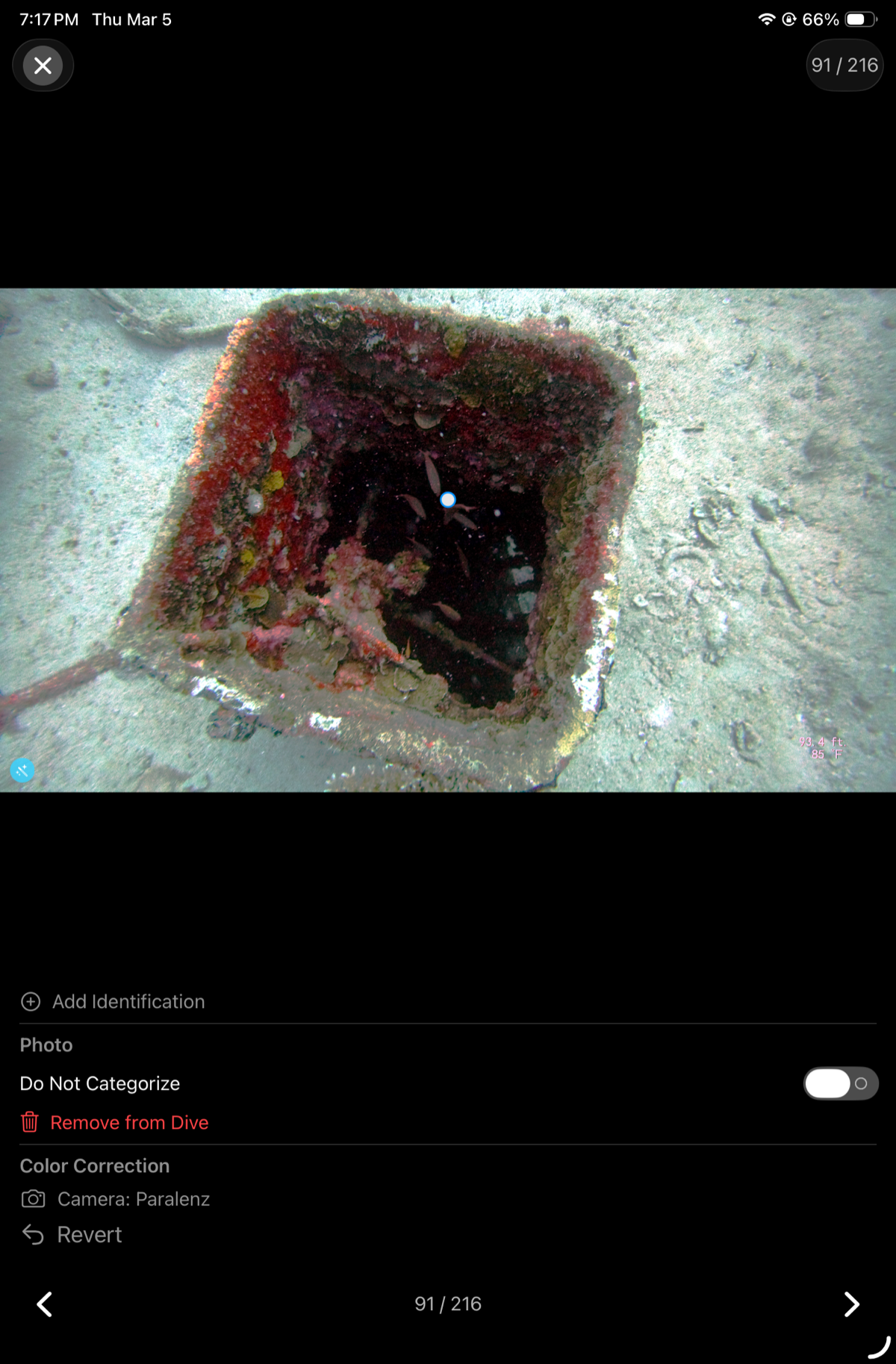
Paralenz camera, 28.5m — wreck hatch, Chuuk Lagoon. See the Color Deep Dive.
More, including the photo sidecar spec we’ve published for comment, is on the Open page.
What we chose to build
DeepSix is built by a small independent team of divers. We decided the dive logs we had weren’t what we wanted to use from here on. So we started from a clean slate, built for reef diving. We didn’t set out to rebuild any app that came before us.
Along the way, tech and cave divers joined us, and they shaped what DeepSix does, from gas mixes to CCR setpoints.
We think logging and reliving your dives should surprise and delight you, and the features and decisions so far reflect that.
Don’t see what you want? Join us on Discord and tell us, or write to [email protected].